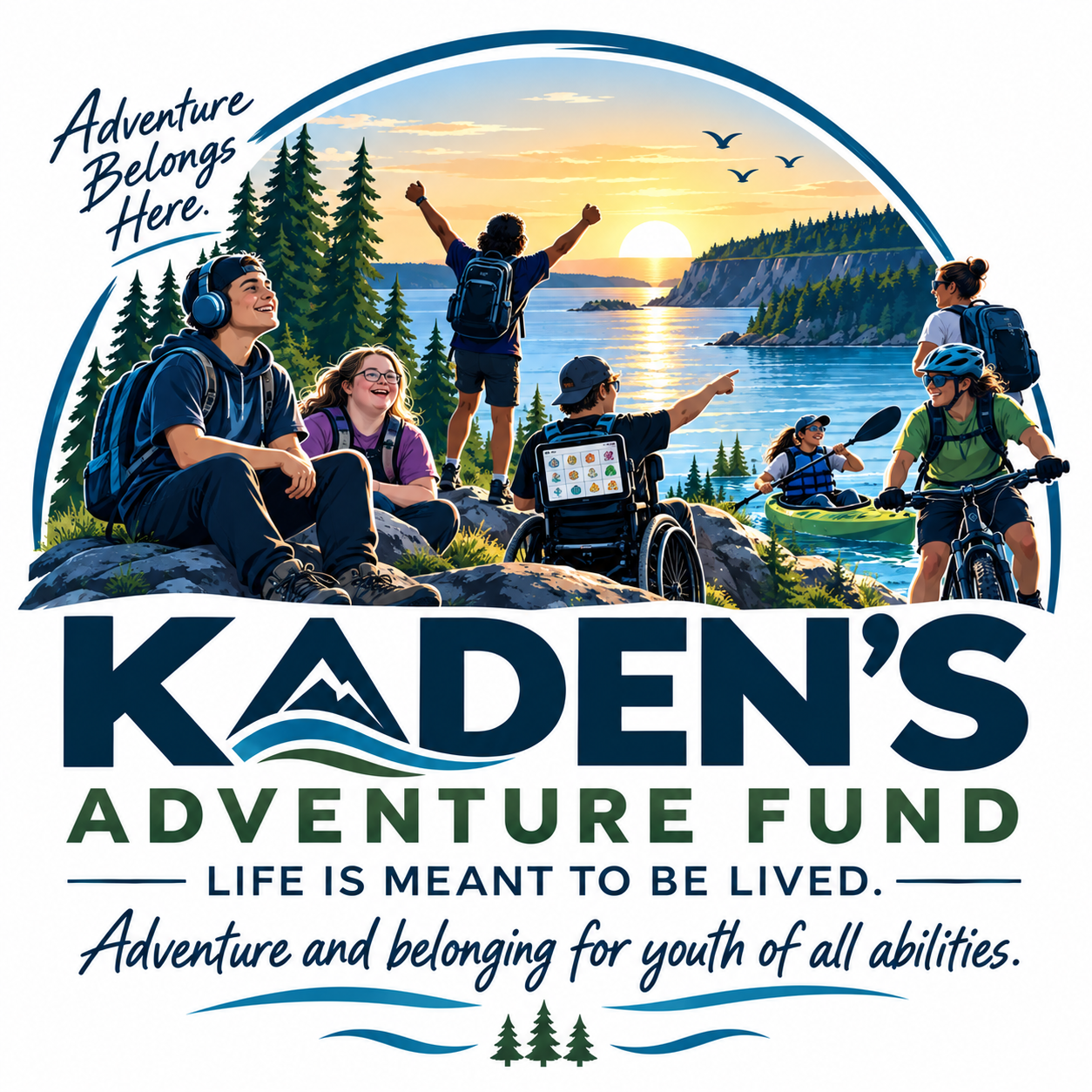
Adventure and healthy activity should reinforce one another. Go hiking because hiking is fun. Swim because someone loves swimming. Healthy habits can grow out of enjoyable experiences — not therapy schedules, not punishment.
Adventure Belongs Here.
What could be possible?
Adventure and belonging for youth of all abilities.
Kaden's Adventure Fund is exploring ways to help teens and young adults of all abilities — including those who communicate in different ways and those who need substantial ongoing support — have greater access to outdoor adventure, physical activity, healthy movement, community experiences, life skills, choice, friendship, new experiences, joy and belonging, and to keep that access as they grow older rather than losing it.
This is not built around problems, and it isn't about fixing anyone. The question is simply: what makes life bigger?
It also starts small and honestly. Kirsten is helping her nephew live an active, healthy, adventurous life. Along the way: notice what works, then ask whether what we learn could help other young people too.
Life skills belong inside real days: packing a backpack, checking the weather, remembering water, ordering food, helping pay, preparing a snack, caring for equipment, putting things away. Practice life by living it.
Independence is not the only successful outcome. Some people will need significant support throughout their lives, and that does not make participation less meaningful. A young person can live a rich, active life while receiving substantial support.
People communicate in different ways — speech, AAC, visuals, pictures, gestures, objects, body language or their own established systems. Never assume non-speaking means unable to choose. Ask what someone wants to do, then build ways for them to answer.
The need for movement, community, purpose, friendship and adventure does not disappear at 18. We want to learn how needs change through adolescence, transition and young adulthood — without creating another artificial age cliff.
We don't need to become the sailing organization, the surf organization, the ski program or the nature center. The better question is: who already does this well, and how could that experience become possible for more people?
Healthy lives as young people grow
Not occasional special events — activities that can stay
As young people move through adolescence and toward adulthood, opportunities for healthy movement, recreation and community participation should continue. We're looking for the activities, routines and experiences that can remain meaningful parts of a life.
- Hiking
- Walking
- Swimming
- Paddleboarding
- Surfing
- Cycling
- Adaptive cycling
- Skiing
- Snowshoeing
- Sailing
- Kayaking
- Fishing
- Fitness
- Parks
- Trails
- Beaches
- Nature
- Gardening
- Community outings
Where this could go
Areas we want to understand
This is not a summer-only question. These are areas for discovery — not services that exist today.
Summer adventures
In development
After-school adventures
In development
School-break adventures
In development
Weekend adventures
In development
Future young-adult opportunities
In development
How we plan to move
Six phases, in order
Phase 1 — Discover
Listen, research, explore, map what exists, design prototype adventures, understand interests and barriers.
Phase 2 — Define
Determine the actual gaps.
Phase 3 — Partner + design
Determine who could help solve them.
Phase 4 — Pilot
Test something small and safe.
Phase 5 — Learn
Determine what worked.
Phase 6 — Decide
Only then determine the appropriate long-term structure.
Right now this is a privately seeded social-impact initiative in development. The long-term structure is deliberately undecided: it might be a partnership initiative, a fiscally sponsored project, an access fund, a mission-driven social enterprise, a program inside an existing provider, an independent nonprofit — or something we discover through the work. Before any real programming begins, professional, legal, insurance and safety review comes first.